UNESCAP Report on Bangladesh Railway Digitalization


 April 28, 2026 2:30 pm
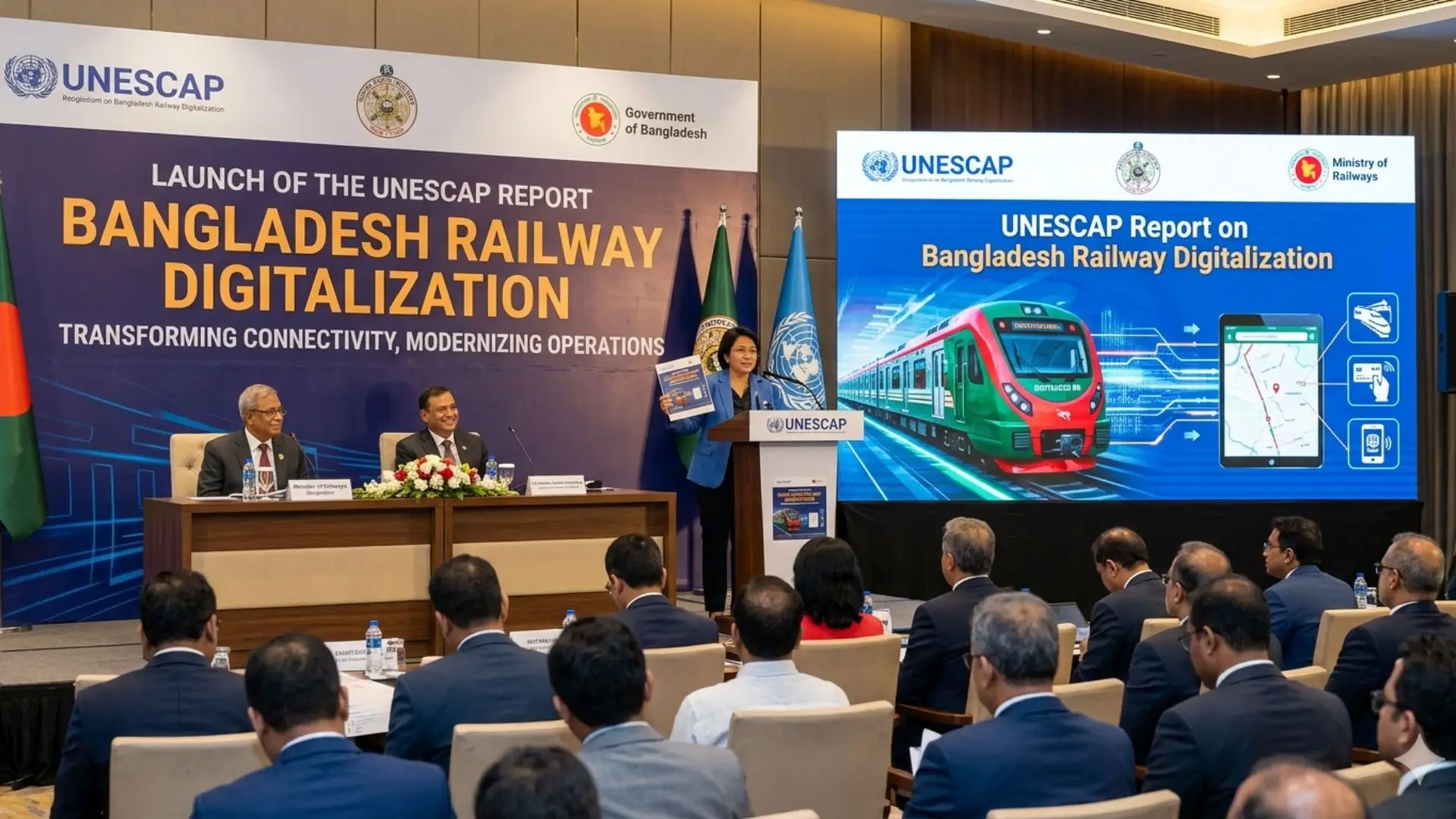
UNESCAP Report on Bangladesh Railway Digitalization reveals how the Ministry of Railways is building a smarter, safer, and more efficient rail network. With 3,018 km of track, 483 stations, and over 50,000 daily e-ticketing users, Bangladesh Railway (BR) is undergoing a massive digital transformation.
This guide covers every existing e-service, future development plans, and how these initiatives align with SDG Goal 9 and the Railway Master Plan 2045. Whether you are a policymaker, investor, or commuter, this article breaks down the technical and strategic roadmap behind Bangladesh’s rail revolution.
Bangladesh Railway at a Glance
Before diving into the UNESCAP Report on Bangladesh Railway Digitalization, understand the scale of operations. Established on 15 November 1862 with just 53.11 km of track, BR has grown into a national backbone.
| Metric | Details |
|---|---|
| Total Route | 3,018.88 km |
| Gauge Type | Both Meter Gauge & Broad Gauge |
| Total Locomotives | 263 |
| Passenger Carriages | 1,764 |
| Freight Wagons | 956 |
| Rail Stations | 483 |
| Workshops | 3 (CLW, Chattogram, Syedpur) |
| Diesel Shops | 4 (Dhaka, Chattogram, Ishwardi, Parbotipur) |
| District Coverage | 43 out of 64 districts |
| Total Land Holdings | 61,860.28 acres |
This vast infrastructure demands modern management. That is exactly why the Ministry of Railways prioritized digitalization under the 8th Five Year Plan and the 30-year Railway Master Plan.
Why Railway Communication Matters?
The Government of Bangladesh places special emphasis on railway communication because it is cheaper, safer, and fuel-efficient compared to road transport.
On 29 January 2018, the Honorable Minister of Railways approved the 30-year Railway Master Plan (July 2016 to June 2045). This ambitious plan includes:
- 230 development projects across 6 phases
- Estimated cost: Tk 5,53,662 crore
- Alignment with: SDGs, Perspective Plan 2041, and 8th Five Year Plan
Goal 9 of the SDGs states: “Build resilient infrastructure, promote inclusive and sustainable industrialization and foster innovation”. Bangladesh Railway updated its Master Plan specifically to align with this goal, incorporating sustainable transport to achieve the 2030 Agenda.
Existing E-Services & Digital Systems
The UNESCAP Report on Bangladesh Railway Digitalization highlights five core digital systems currently operational. These platforms handle everything from passenger ticketing to land management.
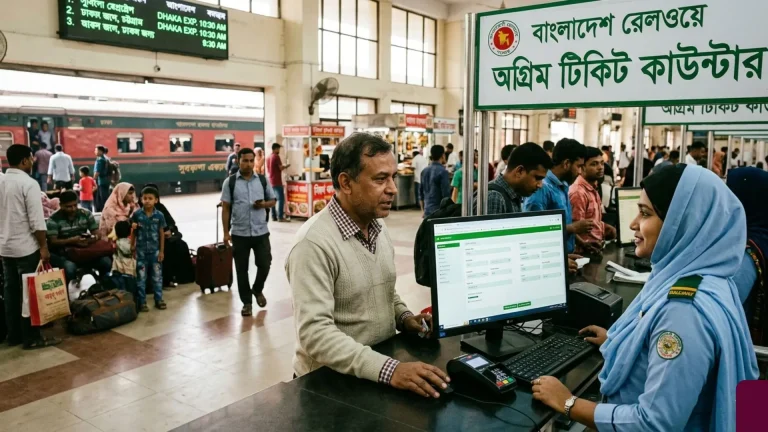
1. E-Ticketing System (Rail Sheba)
The flagship digital service processes approximately 17,000+ tickets daily with around 50,000 user logins.
Current Key Features:
- 3-minute processing time per ticket
- Mobile apps (Rail Sheba) for Android and iOS
- Online payment gateway integration
- E-ticket email delivery and download
- NID integration for identity verification
- Visual seat selection display
- Biometric verification during purchase
- QR Code embedded in every ticket
- Monitoring dashboard for sold/unsold tickets
- Online refund and cancellation
2. GIS-Based Railway Track and Bridge Management Information System
This pilot project digitizes infrastructure maintenance.
Current Key Features:
- Track maintenance records
- Gang and task management
- Mobile app for emergency updates
- Bridge management module
- GIS data management
- Dynamic reporting and monitoring dashboard
Future Plan: Full integration with Bangladesh Railway’s ERP system (under development).
3. Bangladesh Railway Automated Support System (BRASS)
Operational since 2011 and updated in 2021, BRASS manages inventory across all depots.
Current Key Features:
- Stocking application management
- Material receiving and issue tracking
- Automated material demand assessment
- Inventory and stock analysis
- Barcode-enabled material issue/receive for all depots
- Disaster Recovery Center at Parbatipur
- Hosted in ICC Datacenter
Connected Depots: CLW Dhaka, Chattogram, Pahartali, Parbatipur, plus Purchase, Inspection, and Shipping departments.
4. Railway Estate Management System
Managing 61,860.28 acres of land requires precision. This pilot system at Lalmonirhat Division handles:
- Railway land and license information
- E-tendering for land leases
- Master plan integration
- License fee collection and due tracking
- Legal case (mamla) and eviction data
- CS, SA, RS Daag, and Khatian records
- File inventory system
Future Plan: Upgraded GIS database transforming into a comprehensive Land Management System integrated with ERP.
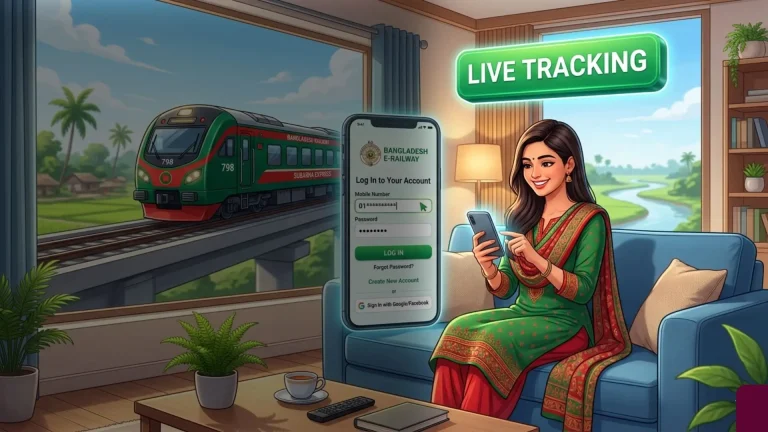
5. Train Tracking and Monitoring System
Passengers can access real-time information via SMS to 16318 using the format: TR [Train Name/Number].
Current Key Features:
- Train departure information
- Next station and stoppage alerts
- Delay notifications
- Live train movement via GPS
- Dynamic reporting dashboard
Road to Smart Bangladesh Railway
The Ministry of Railways has outlined seven critical future digital initiatives under the UNESCAP Report on Bangladesh Railway Digitalization roadmap:
| Future System | Purpose |
|---|---|
| Workshop Monitoring System | Maintenance automation for carriages and locomotives |
| Project Management & Monitoring System | Physical and financial inspection of development projects |
| Automatic Block System | Maintains safe gaps between trains automatically |
| Automatic Train Protection (ATP) | Automatic stopping at red signals |
| Human Resource Management System | Centralized personnel and official information |
| Live Train Tracking (GPS) | Real-time passenger-facing movement display |
| ERP Integration | Unified platform connecting all digital services |
Bangladesh Railway Vision 2041 Journey
The digital transformation follows a clear timeline:
- 2022: Collaborative journey begins
- 2025: Strengthening digitization capacity and quality implementation
- 2041:Smart Bangladesh Railway — sustainable transformation at full capacity
Bangladesh Railway Master Plan 2045 & SDG Alignment
The 30-year Master Plan is not just about laying tracks. It is a strategic document aligning with global sustainability frameworks.
Key Strategic Targets:
- Increase freight market share from 4% to 15%
- Increase passenger market share from 4% to 10%
- Construct 856 km of new rail track
- Undertake 1,110 km of dual gauge double tracking
- Rehabilitate 725 km of existing track
- Procure 100 new locomotives and 1,120 passenger coaches
- Modernize signaling at 81+ stations
SDG 9.1 Alignment: Developing quality, reliable, sustainable infrastructure to support economic development. The UNESCAP strategy specifically identifies digitalizing and decarbonizing Bangladesh Railway as a core strategic thrust for sustainable freight transport.
Benefits & Drawbacks of Rail Digitalization
Benefits
| Benefit | Impact |
|---|---|
| Reduced Corruption | Biometric and QR-based tickets eliminate black market sales |
| Time Savings | 75% reduction in ticketing time compared to manual processes |
| Cost Efficiency | 84% cost reduction for passengers using e-ticketing |
| Data-Driven Decisions | Real-time dashboards enable better resource allocation |
| Safety Improvements | ATP and Automatic Block Systems prevent collisions |
| Transparency | E-tendering for land leases reduces disputes |
| Climate Goals | Rail produces 75% less CO₂ per ton-km than road transport |
Drawbacks
| Drawback | Mitigation Strategy |
|---|---|
| Cybersecurity Risks | ESCAP’s 2025 draft regional framework on rail cybersecurity addresses this |
| Digital Divide | SMS-based tracking (16318) serves non-smartphone users |
| ERP Integration Delays | Phased rollout prevents system overload |
| Staff Training Gaps | BR Training Academy conducts regular upskilling |
| Infrastructure Costs | PPP and foreign aid financing under Master Plan |
Common Implementation Mistakes to Avoid
Based on regional rail digitalization patterns, Bangladesh Railway should avoid these pitfalls:
- Siloed Systems Without ERP Integration: BRASS, GIS, and Estate Management must unify under one ERP to prevent data fragmentation.
- Ignoring Cybersecurity from Day One: As ESCAP’s 2025 meetings highlight, rail networks face increasing cyber threats .
- Insufficient Change Management: Technology fails without staff buy-in. The Training Academy must lead cultural transformation.
- Overlooking Last-Mile Connectivity: Digital services mean little without reliable internet at 483 stations.
- Neglecting Maintenance Budgets: Digital systems require 15-20% annual maintenance funding, not just upfront capital.
Step-by-Step Guide to Using BR E-Services
How to Book an E-Ticket via Rail Sheba
Step 1: Download the Rail Sheba app from Google Play Store or Apple App Store.
Step 2: Register using your National ID (NID) number. The system verifies your identity against the government database.
Step 3: Select your origin and destination stations from the dropdown menu.
Step 4: Choose your travel date and view available trains. The seat selection display shows real-time availability.
Step 5: Pick your preferred seat/berth from the visual coach layout.
Step 6: Complete online payment via mobile banking, card, or other integrated gateways.
Step 7: Receive your e-ticket via email with a unique QR Code. Download or screenshot for boarding.
Step 8: At the station, verify your ticket using the QR Code or biometric check at automated gates.
How to Track Trains via SMS
Step 1: Open your phone’s messaging app.
Step 2: Type: TR [Space] [Train Name or Number] (Example: TR 701 or TR Subarna Express)
Step 3: Send to 16318.
Step 4: Receive instant updates on departure, next station, delays, and estimated arrival.
Frequently Asked Questions
What is the UNESCAP Report on Bangladesh Railway Digitalization?
The UNESCAP Report on Bangladesh Railway Digitalization documents the Ministry of Railways’ initiatives to modernize BR through e-services like e-ticketing, BRASS, GIS tracking, and future systems including ATP and ERP integration. It aligns with SDG Goal 9 and the Railway Master Plan 2045.
How many people use Bangladesh Railway e-ticketing daily?
Approximately 50,000 users log in daily, purchasing over 17,000 tickets through the Rail Sheba app and web portal.
What is BRASS in Bangladesh Railway?
BRASS (Bangladesh Railway Automated Support System) is an inventory and material management system operational since 2011. It handles stocking, demand assessment, and barcode-enabled material tracking across all major depots.
How does Bangladesh Railway align with SDG Goal 9?
BR updated its Master Plan to align with SDG 9 — building resilient infrastructure and fostering innovation. Specific targets include increasing freight share to 15%, modernizing signaling, and constructing 856 km of new track.
What is the Railway Master Plan 2045?
Approved on 29 January 2018, this 30-year plan includes 230 projects in 6 phases costing Tk 5,53,662 crore. It covers new lines, gauge conversion, rolling stock procurement, and full digitalization through 2045.
How can I track my train without internet?
Send an SMS to 16318 with the format TR [Train Name/Number] to receive departure, delay, and arrival information without requiring a smartphone.
What future technologies are planned for Bangladesh Railway?
Future systems include Automatic Train Protection (ATP), Automatic Block System, Workshop Monitoring System, Live GPS Tracking, and a unified ERP platform connecting all digital services.
Conclusion
The UNESCAP Report on Bangladesh Railway Digitalization proves that the Ministry of Railways is not merely modernizing it is fundamentally transforming how 170 million people move. From the e-ticketing system serving 17,000 daily passengers to the BRASS inventory network managing national assets, digitalization is already delivering measurable results.
However, the journey to Smart Bangladesh Railway 2041 requires continued focus on ERP integration, cybersecurity, and staff capacity building. With Tk 5,53,662 crore allocated across 230 Master Plan projects and full alignment with SDG Goal 9, Bangladesh is positioned to become a regional model for sustainable rail digitalization.
Simra Khan
I am Simra Khan, a travel enthusiast and digital creator. I founded this platform to simplify Bangladesh Railway travel for you. My goal is to provide clear, updated guides and booking tips, ensuring your journey across our beautiful country is stress-free.